What CASL covers
Canada's Anti-Spam Legislation (CASL) covers commercial electronic messages: emails, texts and direct messages that encourage the recipient to take part in a commercial activity, such as buying a service, signing up for a program or joining a brokerage. It applies to messages sent to or from a computer in Canada, so it applies when you email Canadian agents from anywhere.
There is no general exemption for business-to-business messages. A narrow one covers messages between organizations that already have a relationship, which a first contact does not have. Even an email that only asks for consent counts as a commercial electronic message.
Consent: express or implied
You need the recipient's consent before you send, express or implied. Express consent is a clear yes to receiving your messages, which you record. Implied consent arises only in the situations the law lists, such as an existing business relationship (a purchase in the last two years, for example) and conspicuous publication. Whoever relies on consent has to be able to prove it.
The conspicuous-publication exception
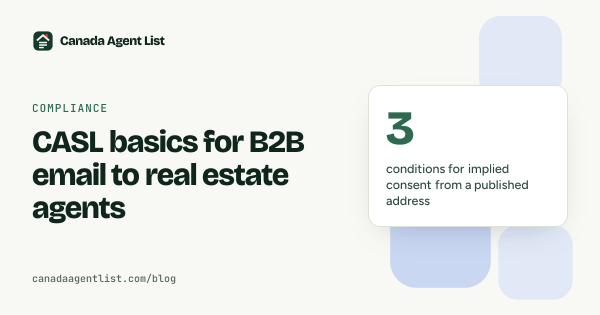
Implied consent applies when a person has conspicuously published their email address, or had it published, the publication carries no statement that they do not want unsolicited commercial messages, and your message is relevant to their business, role or functions. All three must hold, address by address.
For agents, that means a message about their work as a real estate professional: a mortgage referral program, an inspection or staging service, software for agents, an offer to join a brokerage. A message unrelated to that work, such as a consumer product, does not qualify. If the page that shows the address says something like "no unsolicited commercial email", the exception does not apply to it.
Every email in our file was published by the agent or their brokerage on a public page, and email_seen gives the date it was last seen there. The file does not record whether a page carried a no-solicitation statement, and it cannot know what your message is about: you check both.

What every message must include
Each message must identify you, and anyone on whose behalf you send it, and give a mailing address plus a phone number, email address or web address. It must also include an unsubscribe mechanism that costs nothing, is easy to use, works for at least 60 days after you send, and is acted on within 10 business days.
Texts and calls
A text is an electronic message, so CASL treats a text to an agent's cell like an email. Voice calls and faxes are outside CASL; the CRTC's Unsolicited Telecommunications Rules cover them. Calls to businesses are generally exempt from the National Do Not Call List rules, but the other telemarketing rules still apply, including keeping your own do-not-call list. An agent's cell can be a business line and a personal one, so ask counsel how the rules treat yours.
Privacy law
Under PIPEDA, the federal private-sector privacy law, business contact information that is collected, used or disclosed solely to communicate with someone about their employment, business or profession is outside its privacy rules. Quebec, Alberta and British Columbia have their own private-sector privacy laws; check how they apply if you work there.
Honor every request to stop. An agent can also ask us to remove or correct their record through our opt-out page.
Penalties and records
CASL allows administrative monetary penalties of up to $1 million per violation for an individual and $10 million for an organization. Keep records of where and when you found each address, what you sent and when, and every unsubscribe you received and acted on.
This is not legal advice
This page explains the law in general terms. It is not legal advice, and we make no guarantee that any campaign complies. Buyers are responsible for their own compliance, so check your plans with counsel. The CRM import guide shows how to keep email_seen and email_type with each contact.